
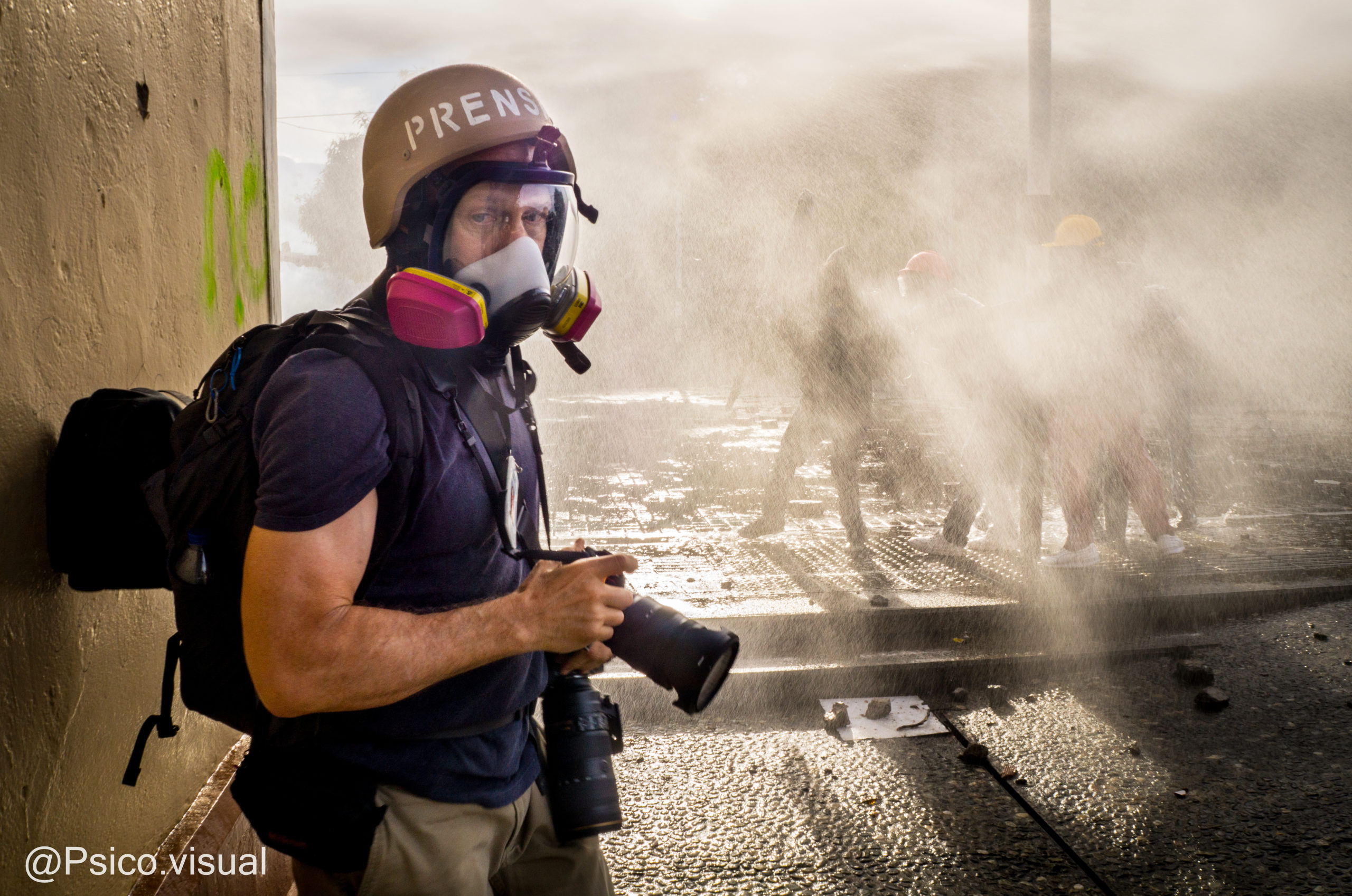
Alum Chris Horn ‘84 Stands on the Front Lines as Photojournalist
Chris Horn had always been attracted to the idea of working alone and embracing dangerous situations. When he discovered that news photographers often work independently, he scoured the Blackburn College library to learn more. He studied books of celebrated war photographers Don McCullin and Sebastão Salgado and, with every image, became more convinced that he wanted to follow in their footsteps.
As it turned out, it’s the perfect path for Horn, now an award-winning photojournalist in Medellín, Colombia.
Graduating from Blackburn in 1984, Horn came to Carlinville as an “Air Force brat” from rural Virginia. Through the College’s Work Program, he was part of “New Con” (new construction), where he learned to arc-weld a steel roof deck, lay brick, and pour concrete. Horn was active across campus–acting and building sets for theatre productions, editing the student newspaper, The ‘Burnian, and being named Student Marshal during his senior year. A semester abroad in Mexico sparked what became a lifelong passion for Latin America.
“Blackburn College gave me a Renaissance education, which was ideal for a young man who had no idea what the hell he was going to do with his life. With Blackburn, you could invent or even reinvent yourself,”
In 2016, Horn immigrated to Colombia with his partner, whom he calls his greatest source of strength. “She immigrated to the U.S. under duress from Chile after the military coup in 1973. Perhaps the only other entity that has impacted me as much as Blackburn College… She is the most courageous, passionate, and principled person I’ve ever known,” he explains.
Horn has been photographing demonstrations and protests in Colombia since 2019. A city of nearly four million, Medellín is a place of striking contrasts, marked by lingering conflict, health and economic effects of the COVID-19 pandemic, drug trafficking, and protests over inequality and police brutality.
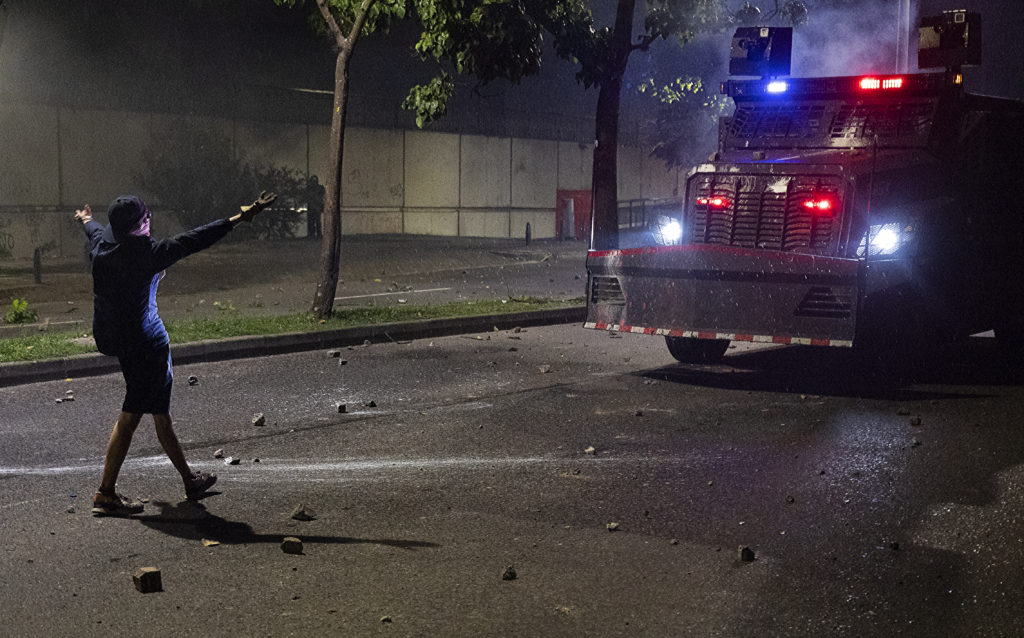
“My reporting is about the forgotten, the misbegotten, survivors, and victims of the never-ending conflict; the refugees, criminals, prostitutes, displaced, LGBT, and the public university students, who all come from impoverished barrios and are fighting a losing battle with a formidable, corrupt state,” said Horn. “I’ve seen Medellín’s terrible darkness, but also her astonishing beauty and grace. For every dangerous actor who threatened or harmed me, I’ve had a dozen or more friends and colleagues rush to my aid.”
He says that, out of all the places he has traveled to, Medellín is the most distinct and paradoxical. The city has taken great strides in healthcare and has one of the most Innovative public transport systems in the world, but it is still an area of occasional riots and illegal drug trade. One of the reasons Medellín is such a huge center of narcotrafficking, Horn states, is because many residents rely on it as a source of income, for better or worse. Yet, above all, Horn says, the people of Medellin are kind.
Given the nature of his work, Horn often faces dangerous and violent situations. While his risks have paid off in the form of awe-inspiring action shots, that doesn’t mean that he is always safe from the brutality around him.
In late 2019, while photographing clashes between police and protesters, Horn was beaten by anti-riot officers, leaving him with a fractured orbital bone reinforced by four screws and a metal mesh. The injury didn’t slow him down. By 2021, he was back in the streets documenting mass demonstrations sparked by a government tax hike during the pandemic—protests marked by police violence that left dozens injured or killed.
His focus has since widened to include Medellín’s transgender sex worker community, the campaign of President Gustavo Petro, and the final phase of the years-long national strike. Most recently, Horn has been covering the public response to “La Escombrero,” a newly opened landfill where authorities are uncovering victims of Medellín’s urban wars, finally offering some families long-awaited closure.
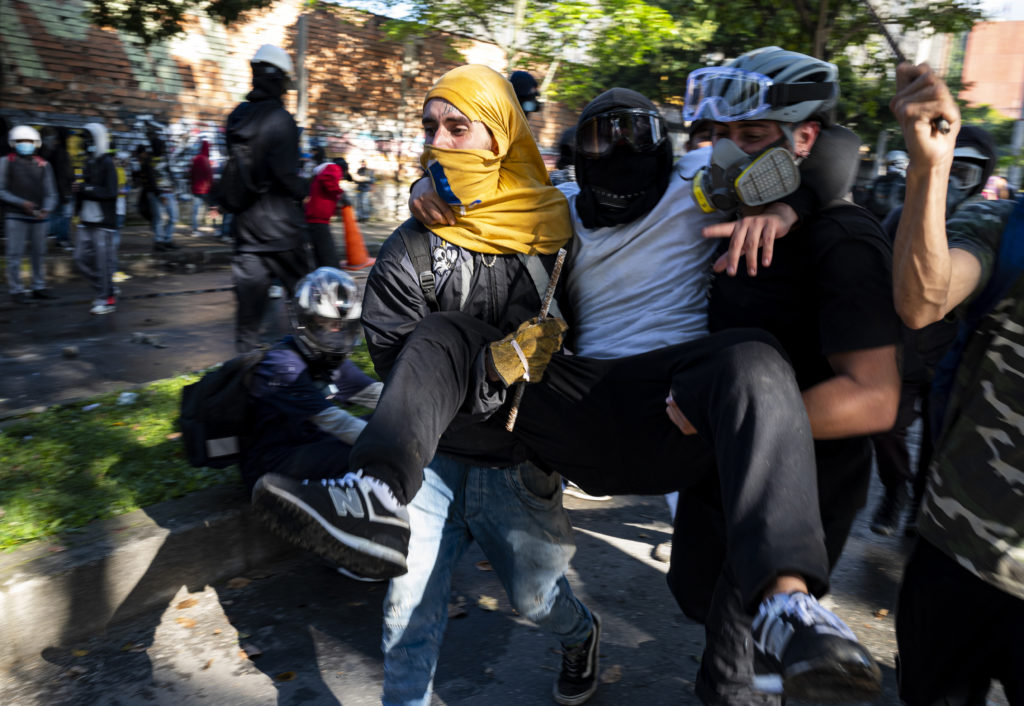
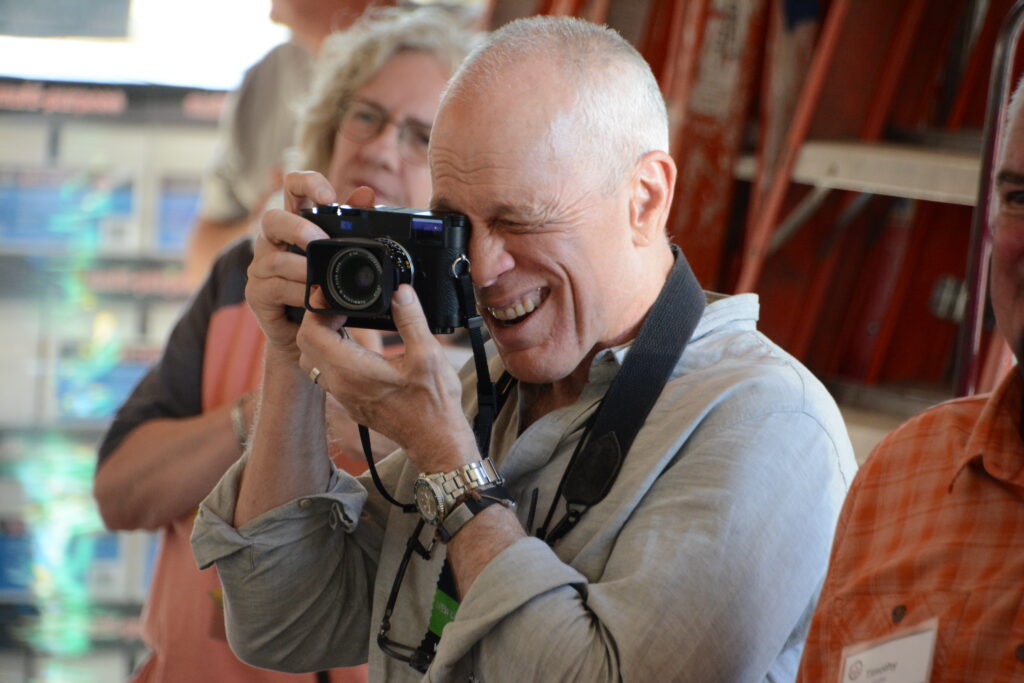
Despite the dangers that can accompany these expeditions, Horn’s photos typically turn out exceptionally well thanks to the skill he has cultivated in the field. He believes that his passion for documenting and telling people’s stories helps him throughout the process. He says, “I don’t have to think much about processes when I’m on the street. Once I’m with my subject or in a situation, instinct takes over. I do, however, obsess about the process at home, with a notebook, poring over contact sheets, masochistically criticizing my performance.” But it pays off. Horn has had several exhibits, publications, and awards for his work over the years.
Horn’s work has earned wide recognition in Colombia. Three of his photographs were honored by Cien Días magazine, including one named among the ten best images of the 2021 National Strike. His photos have been exhibited at the Institute of Fine Arts of Medellín, the University of Antioquia Museum, the EPM School of Music Museum, El Centro Cultural de Medellín, and other venues. His images have appeared in Medellín Living magazine and in the book Memorías en Tiempos Difíciles (Casaletras Press, 2022), which chronicles South America’s national strikes. He has also received one of Colombia’s most prestigious journalism awards for his documentation of social movements and daily life in Medellín.
As for how he finds peace away from his intense and sometimes dangerous work? Once again, he credits his wife. “It is not easy being married to someone who deliberately puts himself in harm’s way, and who does so with a smile on his face. I covered almost every protest, nearly all of which turned into riots, for four years, and joy is the best way to describe how I felt every time I arrived home to see Fernanda. I obviously love her madly.”
When asked about how his time at Blackburn has affected him, he cites the faculty and staff who guided and mentored him. “I also had the privilege to learn from exemplary, demanding professors: James Schiffer, Mitch Clark, Pete Slavish, Melba Buxbaum, Sid Rawlins, and Work Program mentors Paul Tepikan ‘77, Jerome Brooks ‘81, and Roger Caruthers (Dean of Administration in the late 1970s and early 1980s). They continue to exert a profound influence on me,” he explained.
Back to the Dam
Watch Chris Horn ’84 discuss his Blackburn experience during a fall 2025 visit to campus.
“Blackburn College gave me a Renaissance education, which was ideal for a young man who had no idea what the hell he was going to do with his life. With Blackburn, you could invent or even reinvent yourself,” he said.
He cautions anyone considering becoming a photojournalist about the challenges of making a living from it. Working purely on a news photographer’s salary is unrealistic, and many incredible photographers aren’t getting the recognition or pay they deserve. If someone chooses photography as a career, he recommends learning supporting skills such as video and web design. Horn left the profession for about a decade to work elsewhere and save enough money to do the work he does now. “I took a chance, and it paid off.”
“Few in the alternative press do this risky journalism for remuneration. They are among the best citizens I’ve met in Colombia. Here’s to them,” stated Horn.
Looking ahead, Horn is turning his lens toward new projects. Inspired by Luiz García Roza’s detective novels, he hopes to capture images that echo the author’s noir sensibility and atmospheric tension. Closer to home, he plans to document self-taught artists living in Medellín, showcasing their creativity and resilience.